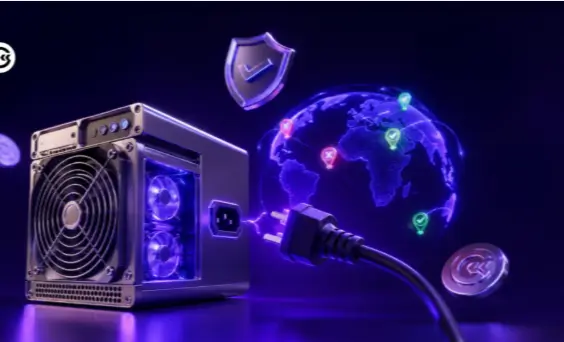
Crypto mining hardware balances efficiency and flexibility. ASICs deliver high hash density with low power draw for specific coins, while GPUs provide broad algorithm support and resilience to protocol shifts. Rig stability depends on matched components, effective cooling, and electrical margins. Real-world efficiency requires data-driven TCO, uptime, and hash-rate stability. The next purchase hinges on evolving algorithms and market forces within a regulatory-aware framework, prompting careful procurement and lifecycle planning that invites closer scrutiny.
How to Choose Between ASICs and GPUs for Crypto Mining
Choosing between application-specific integrated circuits (ASICs) and graphics processing units (GPUs) hinges on the target cryptocurrency, deployment scale, and long-term profitability.
The comparison centers on ASICs vs GPUs, balancing Efficiency vs Cost.
ASICs deliver high hashing density and lower power draw for specific coins, while GPUs provide flexibility, broader algorithm support, and resilience against abrupt protocol shifts; scalability and maintenance inform final selection.
Building a Stable Rig: Motherboards, PSUs, and Cooling
A stable mining rig requires a carefully matched combination of motherboard, power supply, and cooling subsystem to sustain continuous operation and minimize downtime. The selection emphasizes scalable, quality components, electrical efficiency, and thermal margin. A well-designed stable rig balances power density and reliability, with motherboard cooling as a critical constraint. GPU efficiency and stability hinge on verified cooling, robust PSUs, and deliberate airflow management.
See also: How Data Loss Prevention Technology Protects Business Information
Measuring Mining Efficiency: TCO and Real-World Performance
Measuring mining efficiency requires a rigorous, data-driven approach that connects total cost of ownership (TCO) with real-world performance metrics. The analysis emphasizes measurable outputs, not assumptions, aligning performance results with cost. Evaluations cover energy use, uptime, and hash rate stability. Emphasis on choosing hardware based on mining economics, with clear benchmarks and reproducible methodology for real world performance comparisons.
What to Buy Next: Algorithms, Regulations, and Market Trends
What should be acquired next depends on a disciplined assessment of algorithm compatibility, regulatory developments, and prevailing market dynamics. Decisions emphasize transparent benchmarking, power efficiency, and scalable architectures. Algorithm trends guide hardware selection; regulatory impact shapes risk and lifecycle considerations. Market signals refine timing, supply chain resilience, and total cost of ownership. The result is a precise, freedom-embracing procurement strategy.
Conclusion
In evaluating mining hardware, ASICs provide unparalleled energy density for single-algorithm workloads, while GPUs offer flexibility across multiple algorithms and rapid adaptation to protocol changes. A notable statistic: ASICs typically achieve 90–100% of their rated efficiency under optimal conditions, but GPUs sustain performance with broader resilience to regressions and coin pivots. The prudent strategy emphasizes TCO, uptime, and scalable cooling, paired with vigilant market sensing for algorithm shifts and regulatory developments to guide lifecycle decisions.
